Military ground-penetrating radar (GPR) has been deployed to search for and recover the remains of martyrs who sacrificed their lives during the 1968 Tet Offensive along Truong Chinh Street (Dak Cam and Kon Tum Wards), Quang Ngai Province.
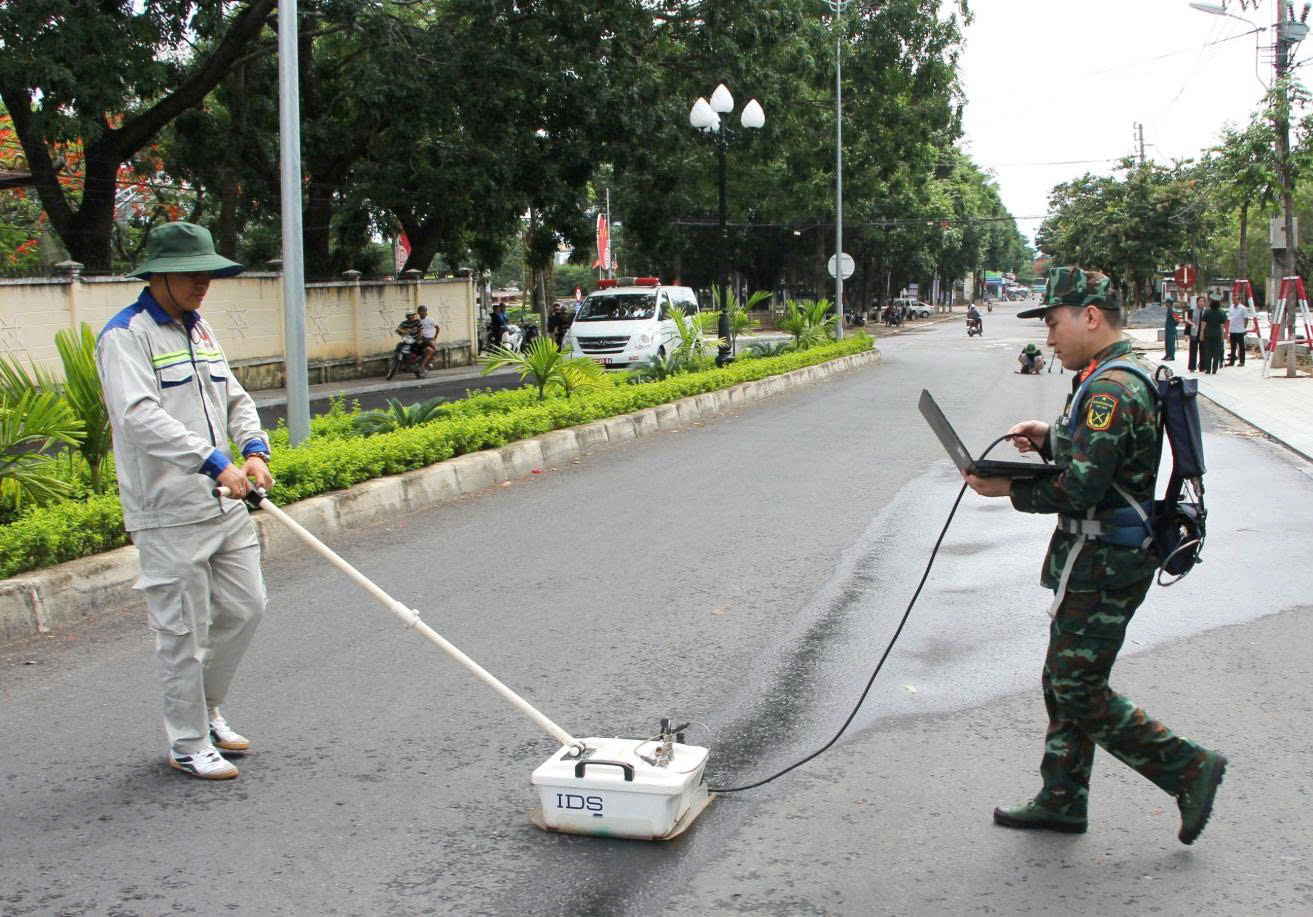
Military ground-penetrating radar deployed at the site in an effort to locate martyrs' remains. Photo: V.T.
Initial assessments by authorities indicate promising signals from the subsurface survey in the search for the remains of soldiers who fell during the 1968 Spring General Offensive and Uprising in Kon Tum.
The search team has agreed to excavate four exploratory trenches across Truong Chinh Street (spanning Kon Tum and Dak Cam Wards), Quang Ngai Province, from June 9 to 10 to narrow down areas suspected of holding the mass grave.
Military Ground-Penetrating Radar Joins the Search
To boost search efficiency, on June 6, experts from the Central Branch of the Institute of Design (under the General Department of Logistics and Engineering, Ministry of National Defense) brought advanced ground-penetrating radar equipment to assist in the survey and identify underground anomalies for the recovery effort.
Senior Lieutenant Colonel Pham Thi Thanh Van, Deputy Director of the Central Branch, stated that the unit dispatched a team of engineers and experts along with the GPR system to assist local authorities.
According to Lt. Col. Van, engineers divided the survey area into multiple cross-sections spaced about 3 meters apart to scan for signals. The collected data is used to generate a subsurface cross-sectional map, pinpointing foreign objects or anomalies. This drastically narrows the excavation zone and minimizes disruptions to existing urban infrastructure.
GPR operates on a signal-reflection principle similar to ultrasound technology but utilizes electromagnetic waves to detect underground objects. Under favorable geological conditions, the device can detect objects, power lines, and underground culverts at depths of up to 6 meters.
Notably, the military's GPR is enhanced with specialized data analysis software that automatically classifies signals, distinguishing common objects like tree roots, plastic pipes, electric cables, or concrete culverts. As a result, anomalous spots are mapped out faster, improving accuracy and significantly cutting down data processing time.
Earlier on the morning of June 4, experts from the University of Science (Vietnam National University, Ho Chi Minh City) also deployed GPR to survey the Truong Chinh Street area.
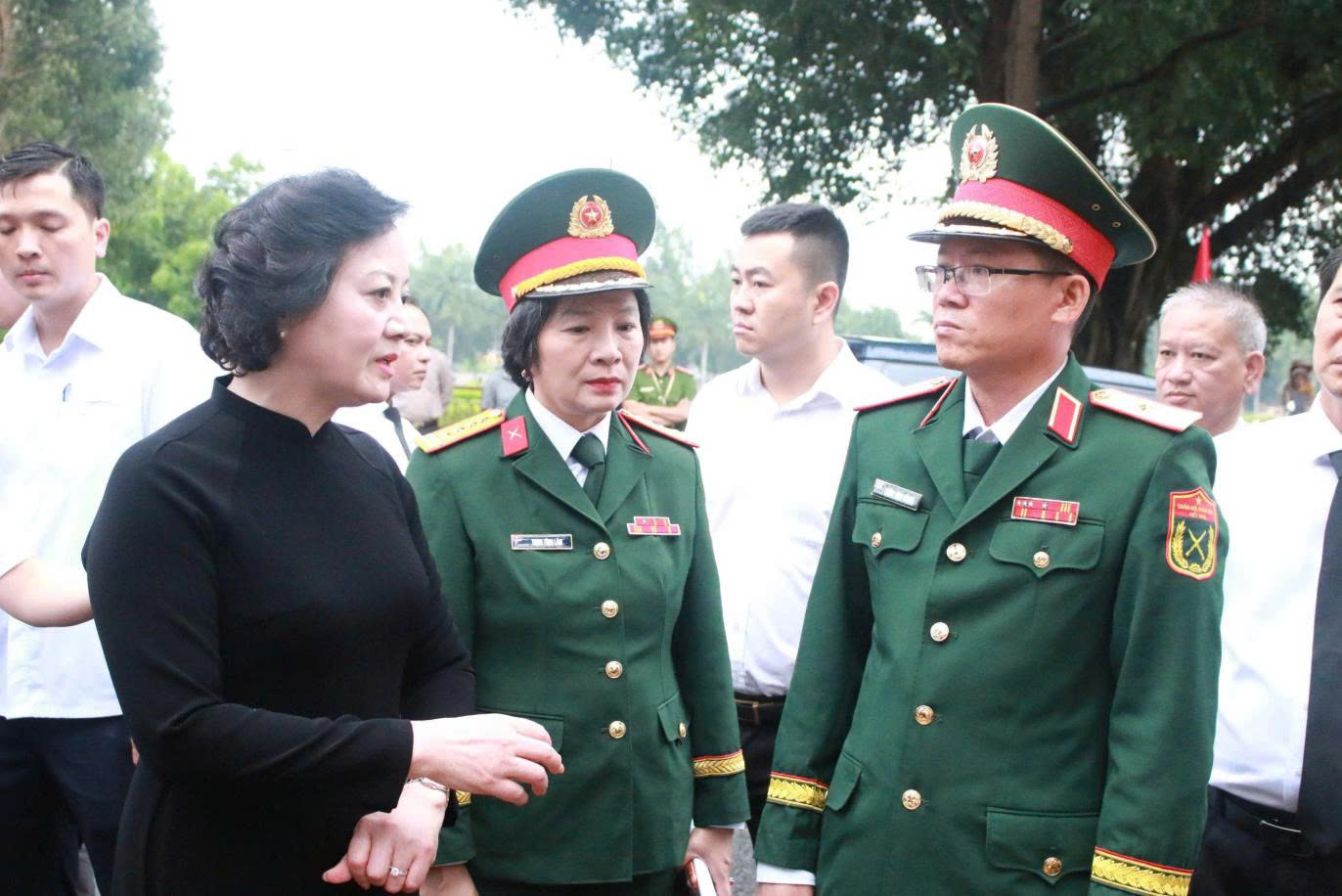
On June 5, Deputy Prime Minister Pham Thi Thanh Tra visited Kon Tum to direct the search operations. She urged the teams to be meticulous and not overlook even the smallest sign, aiming to bring the martyrs back to their families and comrades as soon as possible. Photo: TRAN MAI
Excavating 4 Trenches Across Truong Chinh Street for Exploration
Regarding the search and recovery plan, the Steering Committee for the Search, Recovery, and Identification of Martyrs' Remains of Quang Ngai Province agreed on a two-step exploratory approach.
In the first phase, authorities will dig trenches across Truong Chinh Street with a minimum depth of 2 meters and a minimum width of 60 centimeters. These parameters may be adjusted based on actual field conditions.
The Steering Committee also agreed to add an extra trench in front of the Dê Hồng goat restaurant, as it does not interfere with land compensation or clearance. This brings the total to four exploratory trenches.
Once the exploration phase is complete, full excavations will take place at suspected spots, with the search radius expanded if necessary.
Colonel Mai Kim Binh - Political Commissar of the Quang Ngai Provincial Military Command, Standing Deputy Head of the Provincial Steering Committee - stated that the unit agreed to use excavators to strip the first layer of soil to speed up progress. Afterward, the search work will be conducted entirely manually to ensure caution and meticulousness in the process of verifying signs.
According to Colonel Binh, initial survey results are quite promising. The excavation of the four trenches across Truong Chinh Street is scheduled to take place from June 9 to 10.
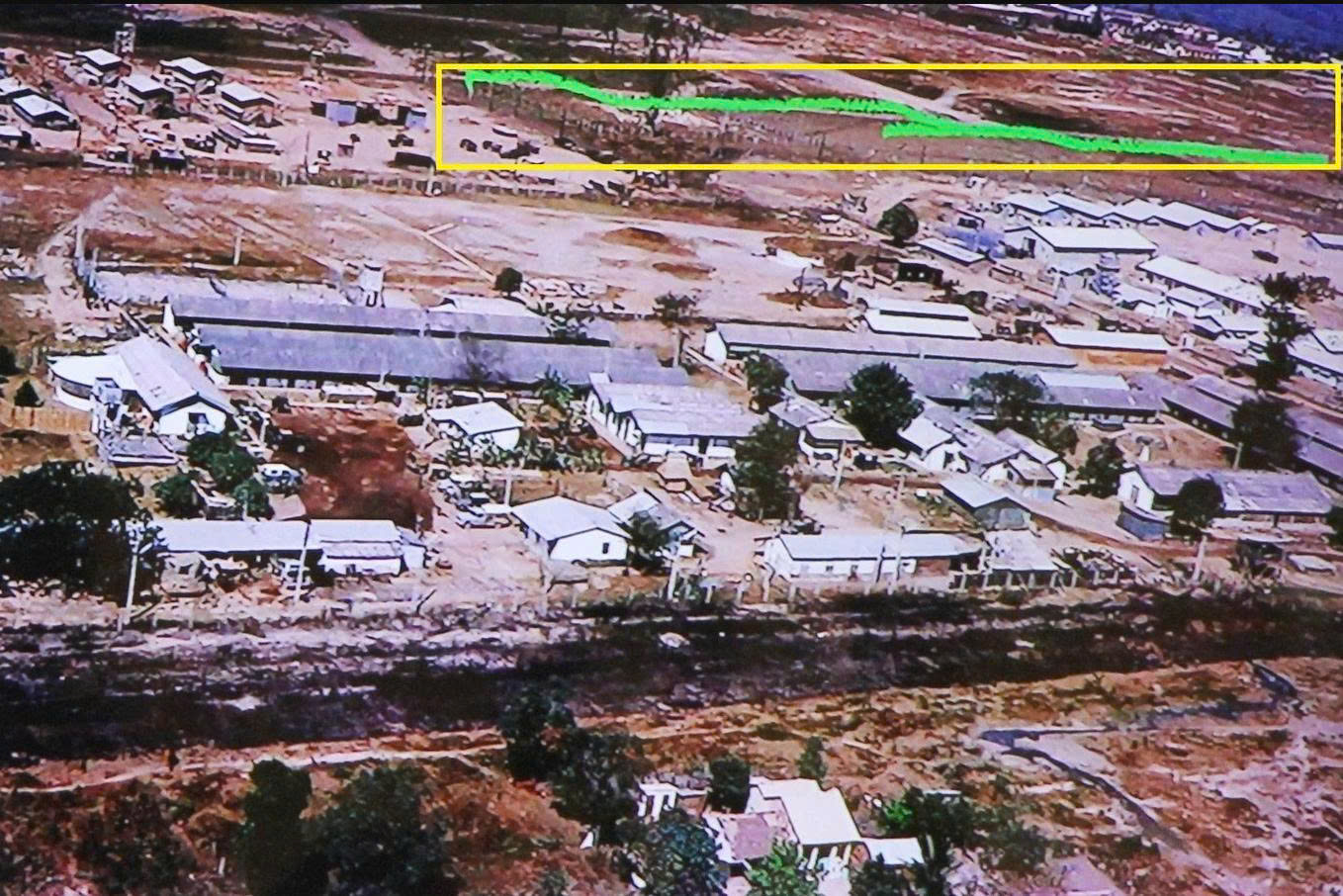
A panoramic photo provided by a U.S. veteran showing the former MACV advisory compound and Special Sector 24; the location of the martyrs' mass grave is marked in blue ink. Photo: Provided by a U.S. veteran to authorities.
(Source: https://tuoitre.vn/)


